




Article: Foot types: can your foot determine your personality?
Foot types: can your foot determine your personality?
According to some studies, the shape of our feet could determine our personality. These theories hold that we walk differently depending on our mood, which makes sense. In fact, if you pay attention to the way some people walk when they are angry or happy, you will notice some common traits.
If this were indeed true, after many years the foot could end up reflecting one of the predominant states of the person walking on them. In such a way that, genetically, our feet could have “passed on” moods or personality traits from our parents’ feet.
Types of feet and their meaning according to their origin
There is even a classification of feet based on our origins:
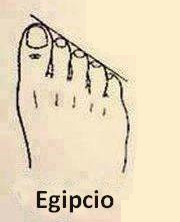
Egyptian foot
The Egyptian foot is characterized by the big toe being the longest, with the others decreasing in length down to the little toe. This type of foot is associated with an enterprising, prominent personality. It is said to come from the rulers of ancient Egypt and Hawaii, who always walked in sandals.
According to this theory, people with this type of foot are proactive and unafraid to take the lead in a project or among a group of friends. They like to stand out and feel comfortable taking on responsibilities. That said, their reputation as natural leaders can also work against them, since they sometimes find it difficult to give up control.
Roman foot
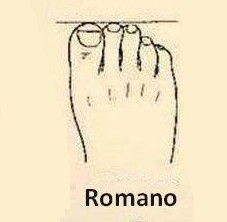
The Roman foot is perhaps one of the most common types. All the toes are more or less the same height except for the little toe. People with this type of foot tend to be shy, but have a deep intellect and are great thinkers.
Their apparent shyness does not mean a lack of character. They are said to be observant people who prefer to think things through calmly before acting. They are usually good listeners and are skilled at analyzing complex situations, which is why they fit the image of thinkers attributed to them by the theory.
Greek foot
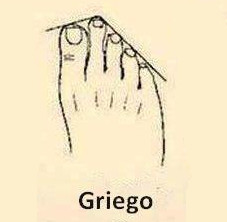
The Greek foot is the type usually seen on Greek statues. The second toe is longer than the big toe, while the others decrease in length down to the little toe. It indicates a hardworking, cheerful, childlike, sociable, and family-oriented personality.
According to the theory, people with Greek feet are closely connected to their inner circle. They enjoy the company of friends and family and are often the life of the gathering. They combine their ability to work with a fun-loving side that always keeps them eager to enjoy themselves.
Germanic foot
Nostalgic and sentimental, the Germanic foot is said to come from Central Europe. This foot usually has a big toe that is longer than the others. The rest form a straight line.
This foot is associated with people with strong emotional memories, who cherish their memories and traditions. They are described as sensitive, loyal, and deeply attached to what feels familiar to them. The straight line formed by their toes is interpreted as a reflection of their orderly and consistent character.

Celtic foot
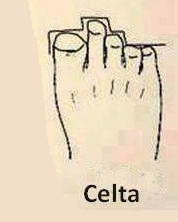
The Celtic foot is the most irregular; the toes usually form uneven steps. It indicates an unconventional and restless personality.
Unlike the others, the Celtic foot is associated with people who avoid routine and established norms. They are usually curious about trying new things and are not afraid to change direction. This restlessness may make them seem absent-minded, but it also gives them uncommon creativity.
Frequently asked questions about foot types and personality
Does the shape of the foot really determine personality?
There is no solid scientific evidence to prove it. This is a popular theory that links foot shape to character traits, and it is best viewed as a curiosity rather than a reliable analysis.
How many types of feet are there according to this theory?
This classification distinguishes five types of feet according to their origin: Egyptian, Roman, Greek, Germanic, and Celtic. Each is defined by the length and arrangement of the toes.
Which type of foot is the most common?
According to the theory, the Roman foot is one of the most common, since almost all the toes are at the same height except for the little toe.
How do I know what type of foot I have?
Simply take off your shoes and look at your big toe and second toe. If the big toe is the longest and the others decrease in length, you have an Egyptian foot. If the second toe extends farther, it is Greek. If the toes form a straight line, it is Germanic, and if they form uneven steps, it is Celtic.
What is the difference between a Greek foot and an Egyptian foot?
The difference lies in which toe is the longest. In an Egyptian foot, the big toe stands out, while in a Greek foot, the second toe is longer than the big toe.
